
Hydraulic Seal Types Explained: Sorting Six Parts by Where They Sit
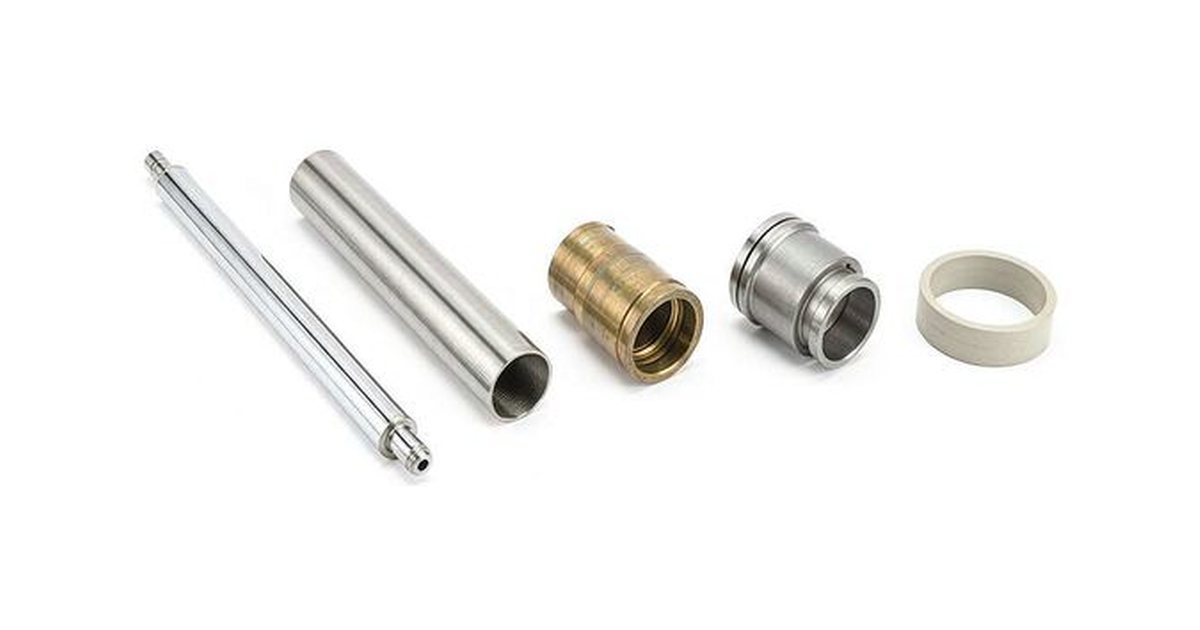
Ask five suppliers to list hydraulic seal types and you will get five different lists. One sorts them by material, one by profile shape, one by whether the cylinder is single- or double-acting. All of those are valid ways to describe a seal. None of them helps a buyer who is holding a dismantled cylinder and needs to know which part is which.
There is a simpler axis: where the part sits. Once you fix the position, most of the confusion disappears, because position determines function, function determines what the part is made of, and the part's failure pattern tells you what to check next.
This page works that way. It walks one cylinder from the bore outward and stops at each part.
Why position beats shape
Two seals with completely different profiles can do the same job in different cylinder designs, and two seals that look almost identical can do opposite jobs. Profile names are design-specific. Position is not.
If you know the part is the outermost ring in the gland, you know it is a wiper no matter what its cross-section looks like. That is a more reliable starting point than trying to match a shape to a catalogue photo.
One cylinder, six parts, ordered from the bore outward
The table below is the spine of this page. Read it top to bottom and you are moving from the pressurised oil out toward the dirt.
| # | Position | Part | Job | Typical series codes in our catalogue |
|---|---|---|---|---|
| 1 | On the piston, against the bore | Piston seal | Separates the two chambers so the rod extends and retracts | SPGO, SPGW, OHM, OUY, KDAS, Glyd |
| 2 | Beside the piston seal or rod seal, on the low-pressure side | Back-up ring | Stops the seal from being extruded into the clearance gap | BRT, BRT2, BRT3 |
| 3 | On the pressure side of the rod seal | Buffer ring | Takes the pressure peaks so the rod seal does not have to | HBTS |
| 4 | In the gland bore | Rod seal | Stops oil from escaping along the rod | UHS, UN, UNS, IDU, IDI, ISI, UPI, UPH, HBY |
| 5 | Outermost, at the gland face | Wiper (dust seal) | Scrapes contaminants off the rod before they enter | DKB, DHS, DLI, DSI, GA |
| 6 | On static joints — gland to barrel, cylinder base, port fittings | O-ring | Seals surfaces that do not move relative to each other | NBR, FKM, EPDM, silicone |
Six positions, six jobs. A typical cylinder uses most of them at once.
1. Piston seal — separating the two chambers
The piston seal is the part that makes the cylinder work. It sits in a groove on the piston and bears against the bore, holding the pressure difference between the cap side and the rod side.
Two consequences follow. First, it is the only seal that sees full system pressure on one face and near-zero on the other, so it is the one most exposed to extrusion. Second, because it slides along the bore for the full stroke every cycle, its wear is distributed along the whole bore length — which means a worn bore damages it everywhere, not just at one spot.
If a cylinder loses holding force, drifts under load, or is slow on one direction only, the piston seal is the first suspect. For how it differs from the rod seal in daily behaviour, see piston seal vs rod seal.
2. Back-up ring — the part that stops extrusion
A back-up ring does nothing on its own. It exists to protect a neighbouring seal.
Every dynamic seal sits in a groove next to a clearance gap. Under pressure the seal material tries to flow into that gap. If the gap is wide enough and the pressure high enough, the edge of the seal is nibbled away — that is extrusion, and once it starts, the seal is finished.
The back-up ring is a harder ring placed on the low-pressure side of the seal to block that path. It is usually made of a stiffer material than the seal itself, and it is usually the cheapest part in the kit and the one most often left out during a rebuild.
A seal that failed by extrusion almost always means the back-up ring was missing, worn, or the wrong size. More on this in backup ring and wear ring.
3. Buffer ring — absorbing the peaks
The buffer ring sits between the rod seal and the pressure chamber. Its job is to take the sharp pressure spikes — the ones produced when a loaded cylinder is suddenly stopped or reversed — so that the rod seal behind it sees a smoother pressure curve.
Without a buffer, those spikes hit the rod seal directly. The rod seal is designed to seal steady pressure, not to absorb shock, and repeated shock shows up as a deformed or split lip rather than as wear.
This is why a rod seal can fail on a machine that has run relatively few hours: the hours were low, but the shock loading was high.
4. Rod seal — the one that actually leaks
The rod seal is what people mean when they say "the cylinder is leaking". It sits in the gland and its lip bears against the moving rod.
It has the hardest combination of conditions in the whole cylinder: pressure on one side, atmosphere on the other, and continuous sliding against a surface that is exposed to everything outside. Its lip geometry is what allows it to hold pressure while still letting a microscopic film of oil pass to lubricate the stroke.
When a rod seal is replaced because oil is running down the rod, the more useful question is what destroyed it. In practice the answer is usually one of three things: the wiper let contamination through, the buffer was absent so the lip was shocked, or the rod itself is scored and is cutting the new seal as it goes in.
5. Wiper — the first line, and the first to fail
The wiper sits at the very outside of the gland, and its only job is to scrape the rod clean on the retracting stroke.
It works in the worst environment of any part in the cylinder — dust, mud, grit, wash water, ice — and it has no lubricant of its own beyond what the rod carries out. That is why, in our own catalogue of 303 seal listings, "wiper" appears in 64 titles, more than "piston seal" at 35. The demand is not evenly spread across types, and the wiper is where it concentrates.
A failed wiper is easy to miss because the cylinder still works. It only becomes visible later, when the rod seal fails and the rod turns out to be scored. Full treatment in wiper seal function and failure.
6. O-ring — the seals that do not move
O-rings seal static joints: the gland to the barrel, the cylinder base, port connections, and the small plugs and valves around the cylinder.
They are the simplest part on this list and the one most often assumed to be interchangeable. They are not. An O-ring is defined by its inner diameter, its cross-section, and its material, and getting any of the three wrong produces a leak that looks exactly like a badly machined groove.
Because they are cheap, they are also the part most often replaced with "close enough". A close-enough O-ring in a static joint will usually hold at first and weep later. Sizing and hardness codes are covered in O-ring kit sizing.
How the six work as one stack
None of these parts works alone. Reading them as a stack is what makes diagnosis possible:
- The wiper decides how much contamination reaches the rod seal.
- The rod seal decides whether oil reaches the outside.
- The buffer decides how much shock the rod seal absorbs.
- The back-up ring decides whether either the rod seal or the piston seal survives at pressure.
- The piston seal decides whether the cylinder holds load.
- The O-rings decide whether the static joints hold at all.
A cylinder that leaks at the rod but has an intact wiper, an intact buffer and a clean rod is a different problem from one that leaks with a destroyed wiper and a scored rod. Same symptom, different cause, different repair. The stack order is how you tell them apart. For the full assembly view, see hydraulic cylinder seal stack.
Real examples from our catalogue
One listing per type, so the abstract table has something concrete under it:
| Type | Product ID | Listing |
|---|---|---|
| Piston seal | p153 | SPGO piston seal ring |
| Rod seal | p160 | UHS piston rod seal, PU U-cup, for excavator / loader / backhoe |
| Wiper | p157 | DKB wiper, metal-rubber composite, for excavator / backhoe / loader / dozer cylinders |
| Buffer ring | p170 | HBTS step seal, PTFE and NBR, rod buffer ring |
| Back-up ring | p290 | BRT back-up ring, nylon PA, for high-pressure cylinder use |
| O-ring | p323 | O-ring kit, NBR / FKM / EPDM / silicone, assorted sizes |
About the counts in this article. Our seals category currently holds 303 listings. Within those titles, "rod seal" appears 68 times, "wiper" 64, "oil seal" 45, "piston seal" 35, "buffer" 26, "dust seal" 21, "O ring" 19 and "backup" 15. These are title word counts, and they overlap — a single title can contain more than one term. They are here to show where demand concentrates, not as a stock figure.
What this page does not cover
Deliberately:
- Dimensions. Inner diameter, outer diameter, height and groove dimensions are a separate subject and a separate article. See how to measure a seal.
- Material selection. Which material suits which duty is its own decision, covered in how to choose hydraulic seals.
- What code letters mean. The series codes in the table above are catalogue identifiers, not a universal standard. Reading them is covered in reading seal profile codes.
- Numbers. This page contains no temperature, pressure, hardness or life figures, because a page that lists types is the wrong place to state limits that depend on the specific part and the specific application.